

If you are thinking about booking a hearing assessment, you may want to know what actually happens before you arrive.
Some people call this kind of appointment a hearing test. At Alto, we call it a Complete Hearing Assessment because the hearing test is only one part of it. The appointment also looks at your ear health, the situations you find difficult, your listening confidence, your lifestyle and the most suitable next step.
The purpose is simple: to understand what is happening, explain it clearly and help you make a more informed decision about your hearing.
What the appointment includes
A Complete Hearing Assessment usually includes:
- A conversation about what you have noticed
- Your medical and hearing history
- An ear health check
- Hearing tests
- Speech-in-noise testing
- A clear explanation of your results
- A discussion about recommendations and next steps
Where appropriate, it may also include a live listening assessment. This helps your audiologist understand how you respond to amplification, what kind of sound feels comfortable, what your preferences may be and what needs explaining before any treatment plan is recommended.
Watch: what happens at your appointment
In this video, Adam explains what happens during a Complete Hearing Assessment and how the results are used to guide your options.
First, we talk about what has changed
Your audiologist will begin by talking with you about your hearing and what you have noticed.
This part matters because hearing difficulty rarely shows up in the same way for everyone. You may struggle in restaurants, miss words on the television, avoid phone calls, find group conversations tiring, rely on someone else to fill in gaps or feel that people are mumbling.
Your audiologist will ask where you notice difficulty, what happens in those situations and what you would most like to improve. They may also ask about tinnitus, dizziness, ear pain, ear fullness, previous surgery, noise exposure, sudden changes in hearing, medication, eyesight, dexterity and any previous hearing aid experience.
Those details help build the clinical picture before any recommendation is made.
We check your ear health
Your ears will be examined before the hearing tests begin.
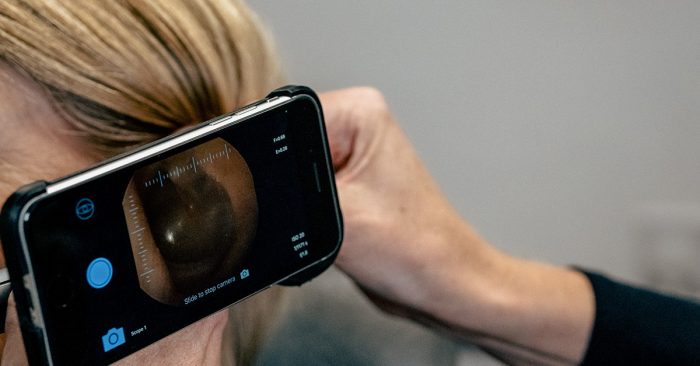
This is called otoscopy. It allows your audiologist to look at your ear canals and eardrums, checking for wax, irritation, signs of infection or anything else that may affect your hearing or the accuracy of the results.
Sometimes reduced hearing is mainly caused by wax. Sometimes wax is only part of the picture. Looking in the ears helps your audiologist decide what should happen next.
A quick middle-ear pressure check may also be used where appropriate. This helps assess how well the eardrum and middle ear are moving.
We measure how you hear
The hearing test measures the quietest sounds you can hear at different pitches.
You will usually listen through headphones and respond when you hear tones at different volumes. The results are plotted on an audiogram, which helps show the degree, pattern and type of hearing loss.
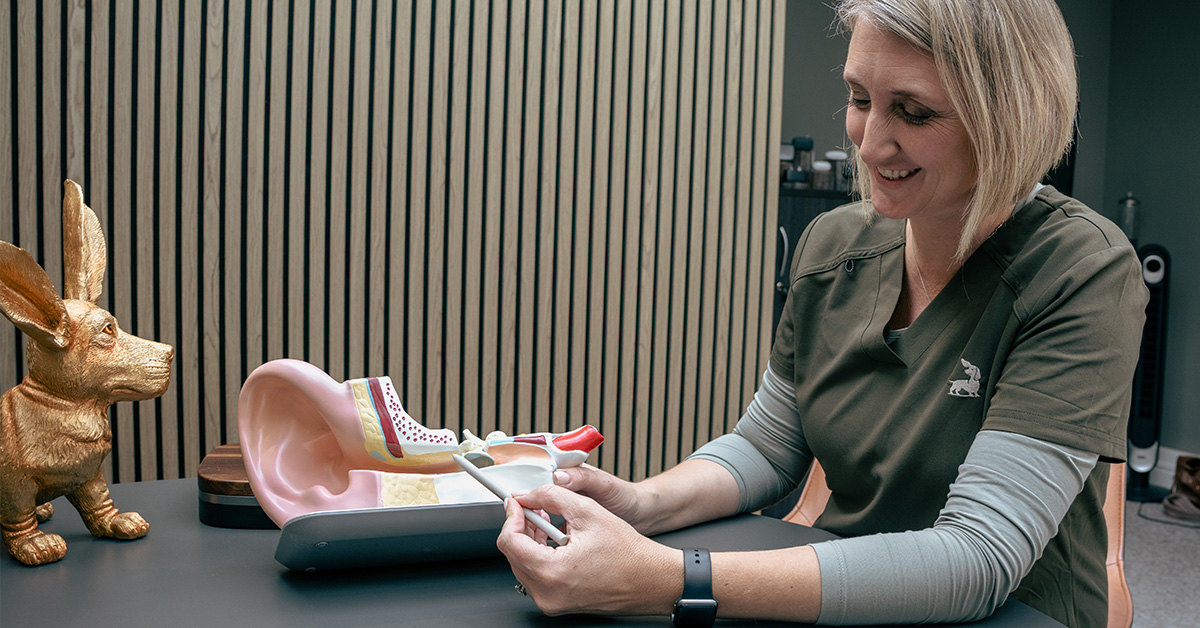
Your audiologist may also explain how the outer ear, middle ear, inner ear and brain work together. This can make the results easier to understand, especially if your main difficulty is clarity rather than volume.
We look at hearing in background noise
A good hearing assessment should connect to real life, not just to a test room.
At Alto, this may include QuickSIN, a speech-in-noise test that looks at how well you understand speech when there is background noise.
This is useful because many people hear reasonably well in quiet but struggle in restaurants, family gatherings, meetings or busy social situations. Speech-in-noise testing helps explain that gap more clearly.
We explain what the results mean
Your audiologist will bring together what you have told them and what the tests show.

Your audiogram shows the softest sounds you could hear at different pitches in each ear. Your audiologist will explain whether there is hearing loss, which pitches are affected and how the ears compare.
We explain these findings alongside your ear health checks, speech-in-noise results and the difficulties you have described. You should leave knowing what we found, what it means for your listening and why we recommend a particular next step.
We may carry out a live listening assessment
Where appropriate, your audiologist may carry out a live listening assessment.

Some people might describe this as a hearing aid demonstration, but that does not quite capture what is happening. This is not about putting a product in your ears and asking whether you like it.
A live listening assessment helps your audiologist see how you respond to amplification in real time. It can show whether extra clarity feels useful, whether certain sounds feel too sharp or too soft, how your brain responds to supported listening and what kind of sound you seem to prefer.
It also helps set realistic expectations. Hearing aids do not restore hearing to normal, and the first experience of amplification can feel different from person to person. Some people notice clarity straight away. Others need a more gradual approach because sounds they have not heard properly for years can feel unfamiliar at first.
This part of the appointment can help guide the recommendation, the fitting approach and the level of support you may need afterwards.
We talk through the right next step
Your recommendation is based on the whole picture.
That includes your hearing levels, ear health, speech-in-noise results, lifestyle, communication needs, confidence, goals and practical considerations.
The next step may be hearing aid fitting and verification, time to consider the recommendation, wax removal, medical review, monitoring, SoundCheck or another follow-up route.
If hearing aids are recommended, your audiologist will explain why, what they may help with and what the process would involve. That should include fitting, adjustment and ongoing support, because hearing aids work best when they are fitted carefully and reviewed over time.
Will I have to decide on hearing aids on the day?
No. A Complete Hearing Assessment is there to understand what is happening and explain your options clearly.
If hearing aids are appropriate, your audiologist will explain why. If they are not the right recommendation, that should be clear too.
Some people are ready to move forward quickly. Others need time to think, talk things through with family or come back with questions. That is completely reasonable.
What will I leave with?
You should leave with a clear understanding of your hearing, your ear health and the recommended next step.
That may include a professional recommendation for hearing aids, a treatment plan discussion, advice about wax removal, a referral recommendation, monitoring, or reassurance that no immediate action is needed.
The important thing is clarity. You should know what was found, what it means and what your options are.
Should I bring someone with me?
You are welcome to bring someone with you to your Complete Hearing Assessment.
That might be a partner, adult child, close friend or someone else who knows you well. Hearing difficulties often affect conversations at home, family life and social situations, so another person can sometimes add useful detail.
They may notice things you have got used to. They may also be able to explain where communication has become harder, how often you ask for repetition, whether group situations have changed or how hearing difficulties are affecting day-to-day life.
This is not about speaking for you. It is about helping your audiologist understand the full picture, so the assessment and recommendation are based on what is happening in real life.
In this video, Adam explains why bringing someone with you can help your audiologist understand the wider impact of hearing loss.
Arrange a Complete Hearing Assessment
To arrange a Complete Hearing Assessment, request a call back from Alto.
You will have time with an experienced audiologist, clear results and guidance on the most appropriate next step.