

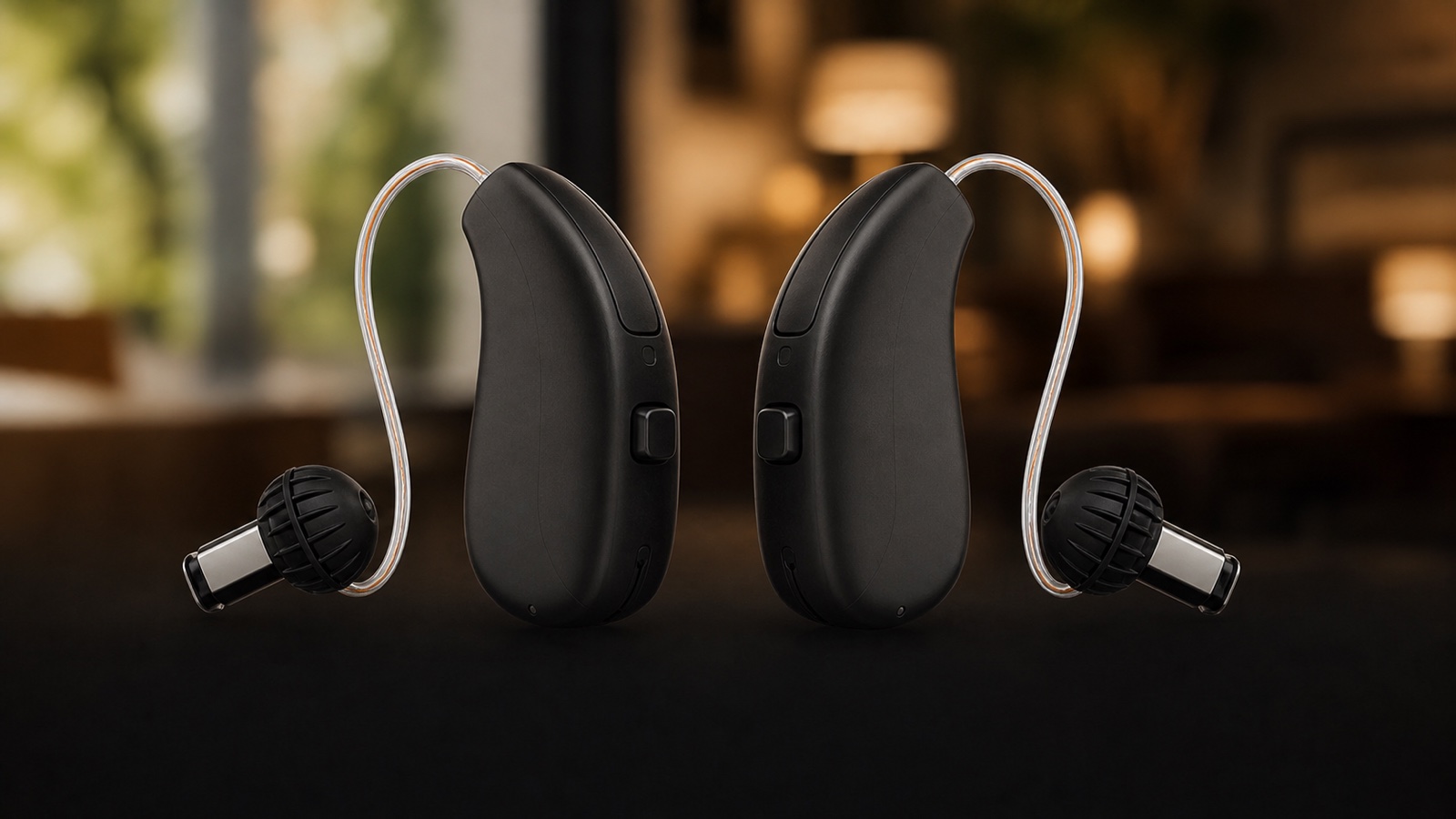
New hearing aids often sound sharper before they sound natural. Speech should be easier to follow, but everyday sounds can jump out at first: cutlery, paper, running water, your own voice.
That does not automatically mean the fitting is wrong. It often means your brain is getting access to speech detail it has not heard properly for a while. The real test is whether conversation becomes clearer without the rest of the world becoming too much.
This page lets you hear the difference for yourself, then explains what is normal, what needs adjusting, and why a proper fitting matters more than the brochure suggests.
Try the listening demonstration
Use headphones if you can. Press Begin, then switch between unaided and aided sound. Try a few scenes. Increase the background noise until speech becomes hard work, then use the hearing aid controls to bring the voice back into focus.
The controls show the kind of work modern hearing aids can do: directional focus, noise reduction, music handling and speech enhancement. It is not a substitute for a hearing assessment, but it is a useful way to understand what a hearing aid is trying to solve.
If you are listening for yourself
Listen for speech becoming easier to pick out. The important change is not simply louder sound. It is whether words need less effort.
If you are listening for someone else
Use the demonstration to understand why volume is not the whole problem. Many people hear that someone is speaking but miss the detail inside the words.
What hearing loss sounds like first
Hearing loss usually does not start as silence. For many people, it starts as missing the edges of words.
The lower sounds in a room may still be easy to hear: traffic, a door closing, a chair scraping, a dog barking. The problem is often higher-pitched speech detail, including s, f, th and t. That is why someone can say, quite honestly, “I can hear you talking, but I cannot catch what you are saying.”
This is also why turning the television up only partly helps. Volume is not the same as clarity. A louder blurry signal is still blurry.
What can feel normal at first
- Your own voice sounding different
- Cutlery, paper or water sounding sharper
- Speech sounding clearer but brighter
What needs reviewing
- Sound that stays harsh after steady wear
- Voices that still sound metallic
- Background noise that makes the aids unusable
What hearing aids sound like when they are first fitted
A new fitting often sounds sharp before it sounds natural. Speech should come forward. Consonants should be easier to pick out. The television may not need to be as loud. But your own voice may sound odd, and some everyday sounds may seem more obvious than they have for years.
This is where people often judge too early. The first hour is not the final sound. The brain has to relearn some of the detail, and the fitting usually needs fine-tuning once you have worn the hearing aids in real life.
At Alto, this is why fitting and verification matter as much as the device. A feature list will not tell you whether the sound is right in your ears. Good hearing care means measuring properly, fitting carefully and reviewing what happens after you leave the clinic.
What should improve
Good hearing aids should not just make everything louder. They should make useful sound easier to reach.
For most people, that means speech becomes easier to follow, especially when the speaker is close and facing them. In a restaurant or family gathering, hearing aids can help give priority to the person you are trying to listen to. In the car, at the television, or around the dinner table, the benefit is often less about volume and more about effort.
Newer hearing aids can use directional microphones, noise reduction and speech enhancement to manage difficult places. Those features can be useful. They are not magic. A noisy room is still a noisy room, and anyone promising perfect hearing in background noise is over-selling it.
If background noise is the main issue, speech-in-noise testing can help show what is happening beyond standard tones in an assessment. That is often where the real complaint sits: not “can I hear a beep?”, but “can I follow the person in front of me when life is happening around us?”
Why the same hearing aid sounds different for different people
Your hearing has a shape. One person may need help mainly with high-pitched speech sounds. Another may need more support across a wider range. The left and right ear can be different as well.
That shape matters. Hearing aids are programmed from your hearing results, then adjusted around your ear canal, comfort, listening needs and real-world experience. Two people can wear the same model and have very different fittings.
That is why this demonstration is most useful when it is based on real results. In a Complete Hearing Assessment, we can measure your hearing properly and show you what amplification changes using your own audiogram.
A useful way to judge the sound
Do not judge hearing aids only by whether they sound impressive in the clinic. Judge them by whether they solve the situations that matter to you.
- Can you follow one person more easily?
- Is the television clearer at a better volume?
- Are restaurants less exhausting, even if they are still noisy?
- Does your own voice settle after regular wear?
If you already wear hearing aids
If you already wear hearing aids and the sound still feels wrong, do not assume you have to live with it.
Sometimes the answer is a small adjustment. Sometimes the hearing aids are not being worn for enough hours for the brain to settle. Sometimes the technology is not well matched to the listening problem. And sometimes the original fitting was never checked carefully enough.
This matters more than the brochure suggests. People do not stop wearing hearing aids because they dislike technology in theory. They stop because the sound is uncomfortable, speech is still not clear enough, the fit is awkward, or the follow-up never dealt with the real problem. If you are in that stage now, our guides on the hearing aid adjustment period and why new hearing aids can sound strange are useful next reads.
If you are trying to understand someone else’s hearing loss
Partners and family members often see the problem first. The television gets louder. Repeating becomes normal. Group conversations shrink because it is easier to nod than keep asking.
The difficult part is that hearing loss does not always feel obvious to the person living with it. From their side, it may feel as though other people are mumbling, speaking from another room or turning away at the wrong moment.
Companion view in the demonstration can help because it makes the problem less abstract. It is not about proving a point. It is about hearing why volume alone does not solve it. If you are trying to support a parent, our guide to helping a parent with hearing loss may help you raise the subject without turning it into a row.
Common questions about how hearing aids sound
Do hearing aids sound robotic?
They should not. Older devices helped create that reputation, but modern hearing aids are much better. A new fitting can sound crisp or bright at first. If voices still sound metallic after a few weeks, the fitting needs reviewing.
Will hearing aids make my hearing normal again?
No. Hearing aids give the brain more usable sound. They do not restore normal hearing, and they do not remove every difficulty in noise. The aim is clearer speech, less effort and better access to the sounds you have been missing.
Why do hearing aids sound tinny at first?
Usually because high-frequency detail has been restored. That detail can sound sharp at first because the brain has not been receiving it properly. With regular wear and sensible follow-up adjustments, it should become more natural.
Can I enjoy music with hearing aids?
Yes, but music needs different handling from speech. Many hearing aids have a music programme that reduces unnecessary processing and keeps the sound more open. If music matters to you, say so at the fitting. It should not be an afterthought.
Our guide to music and hearing aids explains what can affect the sound and how we approach music fittings at Alto.
How long does it take to get used to hearing aids?
The first few days are usually the biggest adjustment. Many people feel more settled after two to four weeks, especially if they wear the hearing aids consistently. Saving them only for difficult places usually makes the adjustment harder.
How can I understand what my partner with hearing loss hears?
Use a simulation based on their hearing results if you have them. It will not be perfect, but it can show why they may hear that you are speaking without catching the words. That is often a better starting point than another argument about the television.
Useful next reads
If this has put a name to something you have noticed, these are the useful follow-on pages.
Getting used to the sound
Fitting, follow-up and support
Hear it in person with your own results
The demonstration on this page uses example hearing results. A Complete Hearing Assessment gives us your actual results, so we can explain what is happening and show how amplification changes the sound for your hearing.
Come on your own, or bring the person who notices the missed words, repeated questions or louder television. It is often easier when both people hear the difference together.